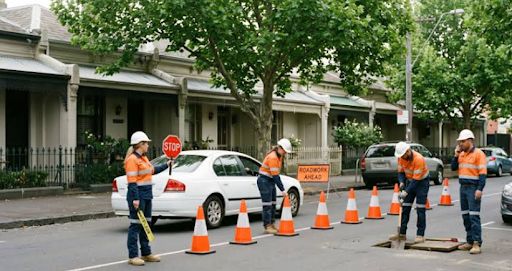
Careful decisions are made for roadworks, since every action can impact workers, drivers and pedestrians. Traffic management training in Melbourne teaches students about traffic control, mindful placement and hands-on experience. Training helps to develop familiarity with the road layout, shared space, site instructions and changing conditions. Students gain an awareness of the ways decisions affect safety and traffic during regular operations. You’ll be able to more easily read unfamiliar road environments more confidently as a result of this preparation. It also helps to create a more structured way of doing things when tasks evolve and there is a heavy workload. That is a strong base for newbies to make traffic roles look like good jobs to do and easier to handle.
Road Awareness
In traffic situations, people do not always operate in the same way as they used to or could in the past when things were simpler. Melbourne traffic management training lets trainers learn how to identify vehicle movement, pedestrian activity and access points, as well as worksite activity. This awareness promotes laborers to observe that they may affect many aspects at once through tiny modifications. More observation leads to safer positioning when traffic patterns and/or nearby activity change. Gradually, reading the road becomes a real practice and not an independent operation.
Site Flow
Good traffic control requires understanding of the traffic flow while people are working along the roads on which they are working. Training provides operational knowledge and principles about guiding road users through temporary arrangements using signage, barriers, lanes and instructions. Every control measure is viewed as a contributing element of a system. From that standpoint, it becomes evident why placement, timing and consistency are important in transitioning site activities. If traffic flow is predictable, then road users can react naturally, and work areas are organised.
Clear Direction
The approach to an active work area may provide an opportunity for road users to get a clear sense of instructions. Training includes using signals that are approved, positioning in a manner that can be seen and using concise verbal instructions when appropriate, as a means to develop communication. Staff are taught how to give good direction, when it takes away uncertainty, not add to it, and how to manage the traffic around them. Clear instructions also assist with colleagues coordinating activities when site circumstances change throughout the day. Repetition helps to facilitate a more fluid flow but remains on the current area.
Practical Judgement
Whilst no one can predict every aspect of your roadwork site, this is where practical judgement becomes of the essence for all roadwork management. Road Traffic Management (RTM) courses in Melbourne focus on what considerations should be taken to decide on the right actions when dealing with possible traffic situations. Participants relate existing processes to traffic flow, weather, access and activity around them. This helps elicit considered replies instead of reflexive actions when unexpected events occur. This is where practical judgement comes in handy, as a worker must be at the same time responsive while keeping safety expectations in mind.
Worksite Confidence
An effective climate of confidence is fostered by an awareness of what to observe, where responsibility starts and when guidance is needed. Training serves as a replacement for uncertainty and thus provides practical knowledge for new, unanticipated road and construction situations. Students get familiar with the typical site invites and must pay attention to local instructions. This familiarity can help to ease the burden of placement but not the thoughtlessness of assumptions. Working with a sense of well-grounded confidence leads to professional behaviour, as workers have knowledge of their capabilities and responsibilities.
Career Value
Traffic management knowledge can be applied to any environment that includes construction, infrastructure, utilities, road maintenance and event-related work. Training helps to create a base, which can be applied when projects and sites shift. With worker discipline and knowledge of controlled movement, establish operational routines easily. The knowledge also supports other aspects of a broad range of practical occupations in terms of safety knowledge. Recognised training can enhance your employability and on-the-job performance if you’re developing industry connections.
Conclusion
Traffic management training in Melbourne can equip participants with a solid platform to successfully organise around traffic. Students acquire skills in the pragmatic aspects of movement, temporary set-up, communication, positioning, and altering of site conditions. The training is helping them make better judgments where there are no recognisable routines to match what is around them. Those are things that help to foster better collaboration among the team, and it helps to understand and handle responsibilities at the individual level. Trained workers can provide better and uniform instructions to road users. Structured preparation can help more new players to understand what they do in an operational environment and make it less confusing and less aimless. If all the practical information has been learned in the early stages, traffic control can be flexible and professionally based.