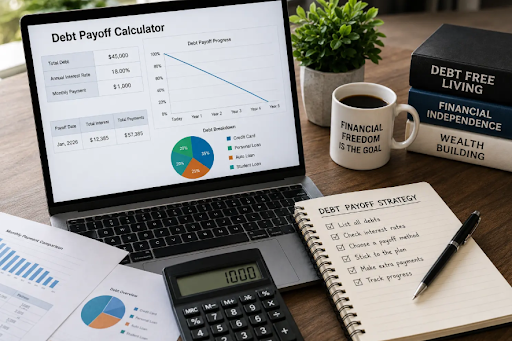
There is a particular kind of financial avoidance that most people recognise in themselves even when they would rather not acknowledge it directly — the pattern of knowing, in a general and uncomfortable way, that the debt situation is not good without ever sitting down to establish specifically how not good it actually is. The anxiety that debt produces is often more connected to the uncertainty about the true picture than to the numbers themselves, and this is a genuinely important distinction because the uncertainty can be resolved in a way that the debt itself cannot be resolved without a plan. Vague financial dread is harder to manage than a clear, specific problem because the mind cannot strategise effectively against something it is refusing to look at directly. A debt calculator forces the honest accounting that most people have been postponing, and what typically follows that accounting is not despair but the particular relief that comes from finally knowing what is actually there.
Clarity That Changes Decision-Making
Understanding the full scope of a debt situation — the total outstanding across all accounts, the interest rates applying to each, the minimum payment obligations, and the actual timeline to repayment under current payment behaviour — changes the quality of financial decisions in ways that operating on a general sense of the situation simply cannot. People who know specifically which debt is the most expensive to carry make different decisions about where to direct discretionary income than people who are managing multiple debts without a clear picture of how the interest is accumulating across each one. The clarity that a debt calculator produces is not simply informational — it is actionable in a way that vague awareness of being in debt is not, and it consistently produces more purposeful financial behaviour from the point at which someone finally has the full picture in front of them.
Seeing Repayment Timelines in Real Terms
One of the more confronting and simultaneously motivating things that a debt calculator reveals is the actual timeline to repayment under different scenarios — how long the current trajectory continues if payment behaviour stays the same, and how significantly that timeline changes when payments are increased, even modestly, above the minimum required. A debt calculator that models these different scenarios side by side produces a visual comparison that makes the impact of additional payments legible in a way that knowing interest rates in the abstract simply does not. The insight that making a relatively small additional payment each month could shorten the repayment period by years tends to produce a shift in motivation that is difficult to achieve through any other means, because the benefit is now concrete rather than theoretical.
Prioritising Debts With Different Interest Rates
Managing multiple debts simultaneously without a clear strategic approach typically produces less efficient outcomes than a method that sequences payments in a way that minimises the total interest paid across the full repayment period, and a debt calculator is the tool that makes this sequencing visible and implementable rather than merely advisable in principle. The difference in total interest paid between directing surplus payments towards the highest-rate debt first versus distributing them evenly across all outstanding balances can be substantial when extended across the full repayment timeline, and most people who have never modelled this comparison are genuinely surprised by the magnitude of the difference when a calculator makes it explicit. Understanding this mathematically is the foundation for a repayment strategy that is genuinely optimised rather than simply structured around feeling balanced.
Reducing the Psychological Weight
The psychological dimension of debt is substantially underestimated in most financial discussions, and the relationship between financial uncertainty and mental health outcomes is considerably more direct than is generally acknowledged in advice that focuses exclusively on the numerical aspects of debt management. Living with unquantified debt — knowing it exists without knowing its true shape — creates a background anxiety that affects sleep, decision-making, and general wellbeing in ways that extend well beyond the financial domain. Producing a clear, accurate picture of the debt situation through a calculator does not resolve the debt, but it consistently reduces the psychological weight of carrying it by converting an amorphous and dread-generating unknown into a specific and therefore addressable problem.
Building a Realistic Repayment Plan
A repayment plan that has been developed against an accurate model of the debt situation is considerably more likely to be maintained than one built on optimistic assumptions about what is owed, how interest is accumulating, and how long the repayment process will actually take. Most repayment plans that fail do so not because the person lacked commitment but because the plan was built without the information needed to make it genuinely realistic, and the gap between the plan and the reality became demoralising rather than motivating as it widened over time. A debt calculator provides the informational foundation for a plan that begins from truth rather than from a best guess, and plans that begin from truth tend to survive contact with reality considerably better than those that do not.
Conclusion
A debt calculator is the starting point for a genuinely informed relationship with a financial situation that most people have been managing at a comfortable but costly distance from the actual facts. The clarity it provides changes the quality of decisions, the structure of repayment strategies, the effectiveness of conversations with financial institutions, and the psychological experience of carrying debt in ways that make it one of the most practically useful tools available to anyone who is ready to stop avoiding the numbers and start engaging with them directly.